You want more enquiries from search, but you don’t want to light money on fire guessing. Many Aussie small business owners feel the squeeze—wanting better leads without throwing cash at uncertain tactics. This piece cuts through that noise.
Think of organic and paid placements as apples and oranges: both put you on the search engine results page, but in different ways. Paid placements buy quick spots; organic work earns them over time.
In the next sections I’ll walk you through six decision factors—speed, cost control, trust, targeting, measurement, and the blend—so you can pick the right strategy for your goal, budget and timeframe.
No drama, no hard sell. From Adelaide to Australia-wide, Chris Lourenco at Loudachris turns search data into actions you can use this week. I’ll share a client win later to show how this plays out in the real world.
Key Takeaways
- Both paid and organic methods get you on the results page, but they work differently.
- Choose based on timeframe—fast reach or long-term growth.
- Control of cost, targeting and measurement varies between approaches.
- A blended approach often gives the best visibility and steady results.
- This guide gives six clear factors to help make the call for your business.
Start here: what you actually need from search
Begin with a simple question: do you need enquiries this month, or can you play the longer game?
Key Takeaways
- Use ads when you need immediate visibility and fast enquiries.
- Use seo when you want compounding visibility that grows over time.
- Blend when you want quick feedback and long-term momentum.
- Measure calls, bookings and store visits — not just clicks or traffic.
Quick visibility vs compounding visibility
Think renting a billboard for a weekend versus building a local shop people recommend. Paid campaigns give instant spots but stop the moment you stop paying.
Organic work takes time, but it can keep sending traffic after the heavy lifting. That compounding effect matters for steady growth.

Lead quality vs lead volume
Paid ads can push a lot of volume fast, but quality hinges on targeting and landing pages. Organic often brings higher-intent searches, though it takes longer to earn trust.
What “success” looks like for your business in Australia
Success is what you define — phone calls, quote requests, bookings or in-store visits. Track conversions that matter to your business, not just raw traffic.
If you want the basics first, check SEO services and Google Ads management for quick reads on each approach.
SEO vs Google Ads: how they work (and why they’re not enemies)
One puts in the hard yards to earn spots; the other buys a front-row seat. Both get your website onto search results, but they do it in very different ways.
SEO: earning organic rankings through site, content and trust
Search engine optimisation means improving your site, pages and content so search engines see you as relevant and trustworthy. It’s about technical fixes, strong content and credibility signals that lift organic traffic over time.
Google Ads: bidding for paid placements and paying per click
Paid placement is a bidding system — you pick keywords, set location and budget, and pay per click. It gives fast visibility and tight control over who sees your ads and when.
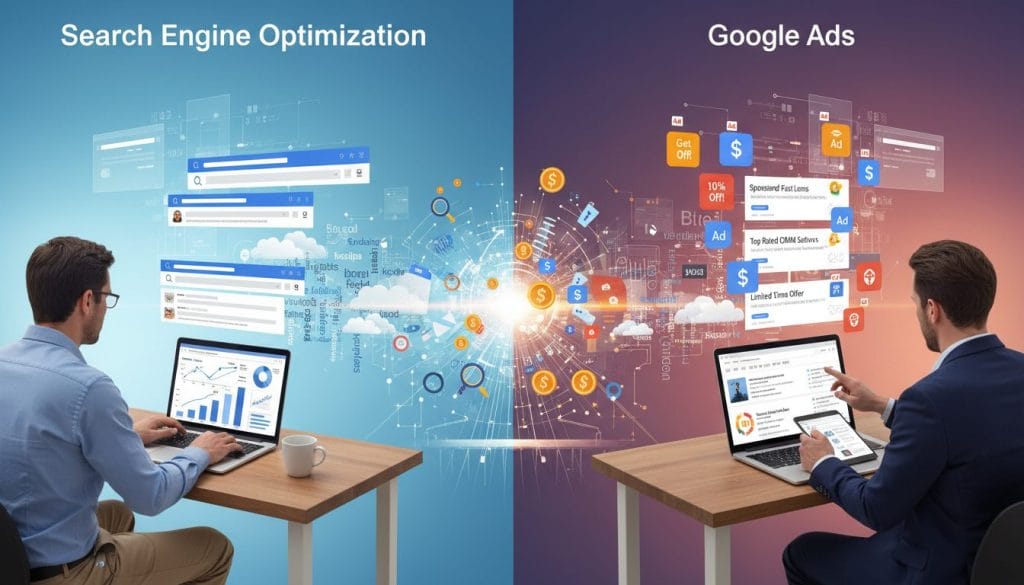
Why the comparison matters — and how they work together
The right question is not which is better, but which job you need done. Use paid tests to check keywords and per click performance, then build site pages and content for the winners.
- Run paid campaigns on 5–10 keywords to test intent and conversion.
- Use those keyword insights to create long‑form pages and local content.
- Over time, reduce paid spend as organic visibility grows across search engines.
Quick tip: treat ads and optimisation as a duet — testing with paid placements speeds up learning for long‑term content wins. Loudachris can help map that workflow if you want a hand.
1) Speed to results: how fast you need enquiries
If you need enquiries fast—launches, limited promos or a new service area—google ads are usually the quickest lever; if you can wait, patience pays as organic work builds stronger momentum and lasting results over time.
When paid campaigns win: use them for emergency trades, event tickets, seasonal sales and end‑of‑financial‑year promos. They can put you on page one quickly and drive traffic in days. That makes them great for testing offers or filling a short window.
Ramp-up reality for paid placement: you can show fast, but performance still needs work. Test calls‑to‑action, landing pages and keyword lists. Poor targeting wastes budget; quick clicks don’t always mean quality enquiries.
When organic wins: high‑consideration services and evergreen offerings suit steady content and local pages. Early months often look quiet, then visits and trust stack as content and authority grow.
“Paid placements stop delivering the moment the budget stops.”
Don’t get tricked—fast clicks are not the same as good leads. If you run paid campaigns for speed, build a dedicated landing page that converts now and later becomes a long‑form service page for organic growth.
- Quick tip: create one landing page per campaign—use it to test messaging, then expand it into an SEO‑friendly page after the campaign.
2) Cost and budget control: monthly investment vs cost per click
One route lets you tweak budgets daily; the other asks for time and steady monthly investment. Paid placement gives tight control and fast feedback, but costs can climb in competitive markets. Long‑term site work needs upfront effort and ongoing spend, yet you don’t pay per click for organic traffic.
How costs look in competitive Aussie markets
In cities like Sydney, cost per click can range from about $5 to $50+ depending on industry and competition. Search Engine Journal notes average PPC benchmarks vary widely by sector, so expect volatility if your keywords are hot.
What you control with paid placement
- Daily budget, max bids and target locations.
- Ad scheduling, negative keywords and landing pages.
- These levers affect your cost per lead and how fast you burn budget.
What organic spend actually buys
Work includes technical fixes, content, local optimisation and link building. You pay for the work, not for each click — but that doesn’t mean it’s free. It’s steady investment that compounds over months.
Budget burn and what optimisation really does
Budget burn means lots of clicks with few enquiries — usually due to wrong keywords, weak landing pages or missing tracking. Real optimisation improves click‑through, quality score and conversion rates. It cuts waste; it doesn’t give magic discounts.
Quick links: Google Ads · SEO
3) Trust, click behaviour and brand authority in search results
Clicks follow trust — and that’s where organic listings usually get the upper hand. Many users prefer unpaid listings because they read as neutral recommendations. Paid placements still win when someone wants to buy now, but the “Ad” label changes behaviour.
Why users often trust organic listings more
Studies show organic results capture the majority of clicks. A Sistrix CTR study found organic listings take the bulk of clicks compared with paid positions, especially for informational searches.
What ad labelling means for clicks and intent
Some people skip anything labelled “Ad” on principle; others click ads because they signal immediate availability. Labels can filter out tyre‑kickers, but they can also reduce clicks in high‑trust categories like health or legal.
Authority building: content, links and credibility signals
Build trust by answering real questions. Create 3–5 service pages and 6–10 supporting articles that solve pre‑sale queries. Add local signals, reviews and earned links to lift brand authority and organic traffic over time.
“Our goal is to provide the most relevant and helpful results.”
Plain English: Google rewards pages that genuinely help the searcher. Focus on useful content and consistent signals, and conversions will follow.
Curious how paid testing can speed content wins? Read more on how paid campaigns can inform content at do Google Ads help SEO.
4) Targeting and control: who you reach and how precisely
If you want to pick who sees your messages down to a postcode and hour, targeting is where the choice gets real.
Direct answer: use google ads when you need tight steering—choose suburbs, radius, business hours, device and intent by keyword type.
Location, scheduling and intent control in paid campaigns
Paid campaigns let you pause or ramp by hour and suburb. That control is perfect for offers that run in a small area or during business hours.
Tip: segment by device and intent—people searching commercial keywords behave differently to those asking general questions.
Service pages, local optimisation and long-tail targeting
Organic work is about well-built pages: one page per service, honest suburb targeting and long-tail phrases people actually use. No spammy town lists—only pages you can support.
Test fast, then scale with content
Run a short google ads test for an offer—validate price and message. If “hot water system repair Adelaide” converts, build a long-form service page and a supporting how-to article.
Local intent: about 46% of searches have local intent (Search Engine Roundtable). That’s why “near me” queries are critical for trades and local businesses.
Want to grow local presence? Start with paid tests, then cement winners in your pages and in your local SEO work.
5) Measurement and ROI: what you can prove (and when)
Measurement tells you whether your marketing actually pays the bills or just burns cash. Paid campaigns usually show value fastest because spend ties to clicks and conversions. Organic work can feel fuzzy early, then often lowers cost per lead after months of steady work.
Why paid ROI is usually clearer early on
With paid placement you see cost per click, cost per conversion and quick A/B test wins. That makes return on spend easy to calculate and adjust every day.
Why organic ROI often looks better after 6–12 months
Industry studies find most organic gains take 6–12 months to mature (Ahrefs/SEMrush). Over that time, cost per lead often falls as traffic and trust build.
Attribution basics: calls, forms, bookings and offline conversions
If it’s not tracked, it didn’t happen. Set up GA4, link conversion events to your google ads account, use dynamic call tracking and record offline wins in your CRM.
- Track calls with dynamic numbers.
- Send form and booking events into GA4 and your CRM.
- Record offline conversions—quotes accepted and jobs won.
“After fixing tracking and rebuilding one landing page, a plumbing client cut cost per lead by 35% in eight weeks.”
6) Side-by-side comparison table: SEO and Google Ads at a glance
Need a one-glance decision? This table matches timeframe, budget tolerance and competitive heat to the channel that fits — or the blend that keeps you sane.
Best use cases by timeframe, budget and competition
| Ads | SEO | Blend | |
|---|---|---|---|
| Speed | Immediate visibility | Slow build, compounding | Ads for quick tests, SEO for follow-up |
| Cost model | Pay per click; daily budget control | Monthly investment in content and tech; no per-click fee | Use ads to validate; invest in pages that win long term |
| Control | Precise targeting by suburb, hour and device | Control via pages, local signals and content | Test audience with ads, then scale with content |
| Trust | High intent, but labelled as paid | Builds authority and organic trust over time | Use paid social proof while authority grows |
| Best for | Launches, promos, urgent enquiries | Evergreen services, brand authority, steady traffic | Short-term offers validated then turned into service pages |
| Risk | Cost spikes in competitive markets* | Slow ROI; requires steady work | Lower risk if you test before heavy investment |
| Measurement clarity | Clear cost per conversion and fast A/B results | Harder early; clearer after months of data | Use ads to feed conversion metrics into content |
| Long-term value | Stops when spend stops | Compounding visibility and authority | Ads act like an espresso shot; SEO is the slow cooker |
*Footnote: competitive cost per click can be high in Sydney and other metros — factor that into your monthly budget and bids.
Decision shortcut
- New business: start with ads for quick enquiries, then build pages for long-term traffic.
- Established business: blend—fill gaps with ads, lower spend as pages pick up steam.
- Seasonal business: heavy ads around the season, SEO to capture repeat organic interest.
Tip: I use this shortcut with clients—test fast, then back winners with content and local pages.
Conclusion
Match your marketing to the problem—fast enquiries need a different tool than long-term visibility.
Speed: use google ads for quick leads. Cost: pick the route you can fund month-to-month. Trust: organic work builds authority over time. Targeting: paid campaigns let you steer by suburb and hour. Measurement: paid gives fast clarity; site work pays off later. Blend: test with paid, then lock winners into long-form pages and local signals.
Next step — write your timeframe (30 days or 6–12 months), your monthly budget and target suburbs, then choose the mix that matches. Note ACCC guidance: ads must be clear and accurate.
Book a free audit at loudachris.com.au or book a free audit. See client results at client results and more guides at marketing guides.
FAQ — Is SEO better than Google Ads? It depends on timeframe and goals. Use paid for fast tests, then build site pages for compounding visibility.
How much should I budget for Google Ads? Start small, track conversions and adjust. Competitive keywords raise CPC; set daily caps and measure cost per lead before scaling.
How long does SEO take? Expect months; meaningful gains often appear in 6–12 months as content and authority compound.
FAQ
What’s the main difference between organic search and paid search ads?
How do I decide if I need fast visibility or long-term growth?
Can paid campaigns and organic work together?
Which option gives better leads — more volume or higher quality?
How much should I budget for paid search in competitive Australian markets?
What does optimisation actually change in my monthly spend?
Do users trust organic listings more than paid placements?
How precise is targeting with paid campaigns compared with organic tactics?
Which delivers clearer ROI and when will I see it?
Should I test offers with ads before committing to a content strategy?
How do local businesses make the most of both channels for “near me” searches?
What should I measure to compare performance fairly?
How much initial work is needed to start seeing organic gains?
Is one channel better for building brand authority?
Can small businesses afford both strategies?
How should I use keyword data from paid campaigns to inform content?

Chris Lourenco is the director of Loudachris Digital Marketing, an Adelaide-based SEO, Google Ads, and web design agency. Chris excels in crafting bespoke, results-driven strategies that help businesses get more traffic, leads and sales.