Straight talk: this is about booked jobs, not more traffic for the sake of it.
Roofing search results are crowded and homeowners compare providers before they ring you. With 5,000+ roofing companies chasing page one (Safari Digital), standing out is urgent but doable.
This page is a practical checklist you can run through in a week and keep improving each month. Think GBP fixes, suburb pages, citations, technical clean-up, links, reviews and tracking.
Expectations first: seo is a system, not a one-off tune-up. 2026 only gets tougher, so plan for steady wins rather than quick hacks.
You’re the hero here — you do the work, we guide it. I’m Chris Lourenco from Loudachris, and I’ll point out the practical moves that get measurable visibility without fluff.
Key Takeaways
- Focus on fixes that turn searches into booked jobs.
- Sort core GBP and suburb pages in the first week.
- Keep citations, reviews and technical clean-up on a monthly checklist.
- Track results — the data tells you what to scale.
- Make small, steady improvements for long-term visibility.
Why local SEO matters for roofers in Australia
Being seen in the suburbs you work in is what turns clicks into booked jobs. Show up for the exact search homeowners use — “roof repair + your suburb” — and you’re more likely to get the call, not just a visit to your site.
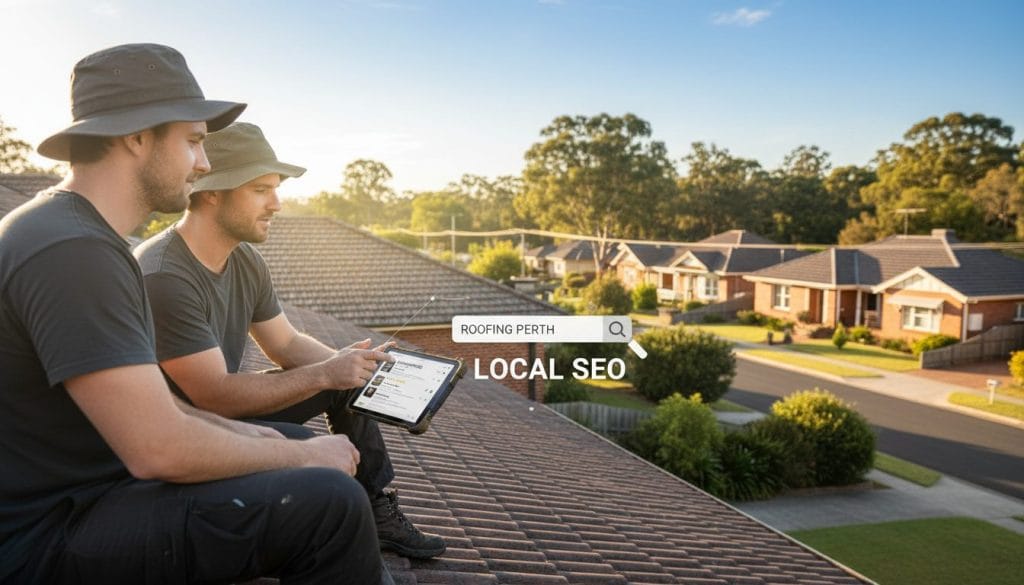
There are more than 5,000 roofing companies in Australia chasing page one (Safari Digital). Page one is packed, and the Map Pack often takes the clicks before organic links get a look.
Homeowners usually search, shortlist 2–3 options, check photos and reviews, then ring one. Visibility here means calls, quote requests and booked inspections — not empty traffic.
- Show for suburb + service queries and you get more genuine leads.
- Map pack placement steals clicks; fixing your profile matters fast.
- Clear photos, solid reviews and up-to-date info convert browsers into customers.
| What shows up | Why it matters | Outcome |
|---|---|---|
| Map Pack | Top visibility on search engine results pages | More calls, higher quote rate |
| Suburb pages | Matches local intent | Better qualified leads |
| Reviews & photos | Trust signals for homeowners | Faster bookings |
With the competition stat above, you need a plan — quick wins first, then deeper work like pages, links and technical fixes. Want an ad vs organic angle while you wait? Check Google Ads for roofers.
Key takeaways you can act on this week
Start simple. Do four focused tasks now and you’ll stop leaking leads. These moves prioritise visibility where it matters — the Map Pack and job-ready searches — not vanity metrics.
- Fix your google business profile first — if details are wrong you’re basically invisible in the Map Pack.
- Build suburb + service pages that match the jobs you want, not big-volume keywords.
- Make NAP citations consistent everywhere before you chase or buy links.
- Track real leads: calls, quote forms and booked jobs by suburb and service.
Fix your Google Business Profile before you touch your website
Update hours, categories, services and a service area that matches where you work. A clean profile feeds the Map Pack and lifts trust.

Build suburb and service pages based on real search intent
Map each page to one task — e.g., “roof repair + [suburb]”. Use basic keyword research and write for the job, not search volume.
Get your NAP citations consistent, then earn better links
Fix name, address and phone across directories first. Backlinks matter (~30% of rankings) but only after foundation signals are solid.
“Backlinks move the needle, but only when your listings and on-site signals are correct.”
Track calls and quote requests, not “rankings vibes”
Measure leads by suburb and service. Use call tracking and form funnels so you can see where quote-ready traffic comes from.
| Action | Why it matters | Quick win |
|---|---|---|
| Google Business | Drives Map Pack visibility | Update hours, photos, services today |
| Suburb pages | Matches search intent | Create 3 pages for top suburbs |
| NAP & tracking | Foundation for links & measurement | Audit listings and add call tracking |
Next: the following sections unpack each tip with step-by-step tasks, plus what to expect from an agency when you hand this work over.
What to expect from a local SEO roofing company (and what to bin)
A solid digital plan begins with a health check, then steady execution. Start with an audit that finds broken foundations, fix business listings and technical issues, then build suburb and service pages that actually bring quotes.
Local Map Pack vs organic results: where the leads usually come from
The Map Pack grabs a huge slice of page one for roof searches (Safari Digital). That means many calls start there, while organic pages bring steady, lower-cost leads over time.
Good service balances both — GBP work and targeted pages for suburbs and services, not broad keywords that waste effort.
“Set and forget” is a myth: why ongoing tweaks win
Google and competitors change constantly. Ongoing reporting and monthly tweaks keep your presence competitive, so your forms and calls rise, not just rankings or traffic metrics.
The red flags: vanity metrics and risky shortcuts
- Reporting only on rankings
- Pushing generic keywords like just “roofing”
- Buying spammy backlinks or no account access
- No conversion tracking or unclear deliverables
“Start with audits, fix foundations, then scale — that’s the right sequence.”
What good looks like: GBP fixes, suburb/service pages, technical cleanup, citation consistency, a review system, ethical links and monthly refinement. Next we compare organic work to paid ads so you can pick the right mix.
Comparison: SEO vs Google Ads for roofing leads in 2026
Paid ads put leads on tap — SEO builds the hose you keep for years. Ads deliver speed; organic work builds lasting presence. Choose based on budget, timing and whether you need instant call volume or a steady stream of enquiries.
CPC reality check
Average CPC for roofing terms sits around $5–$15+ per click, depending on suburb and service. Emergency search terms push that higher, so expect spikes during storms.
Simple cost-per-lead maths
Example: at $10 per click, 10 clicks = $100 per enquiry. If 10 enquiries make one conversion, that’s $1,000 per conversion. Better landing pages and higher conversion rates cut that cost fast.
When to run ads, when to invest in SEO — and when to do both
Ads are a tap: turn them on for storms, new suburbs or promotions and leads flow. Turn them off and the flow stops.
SEO is an asset: it compounds over months and lowers long-term cost-per-lead.
| Aspect | SEO | Google Ads |
|---|---|---|
| Speed | Slow build | Immediate |
| Cost curve | Upfront work, lower long-term cost | Pay per click, ongoing spend |
| Lead quality | Often higher intent from pages | Good for urgent, high-intent queries |
| Tracking | Needs forms and calls set up | Easy to measure per campaign |
| Best use | Baseline demand, growth | Storms, promos, trialling suburbs |
“Whichever path you pick, it still needs the right pages, tracking and reviews to turn clicks into booked jobs.”
Tip: Nail your Google Business Profile for Map Pack visibility
Fix your Google Business Profile first — it’s often the fastest way to lift calls without touching the site. Optimising the right fields gets you in front of homeowners in the Map Pack, where most searches turn into calls. This is a practical, job-focused move you can do this week.
Categories, services, service areas and photos that actually help
Set a precise primary category, add relevant secondary categories and list services with clear names. Define service areas for the suburbs you work in and keep opening hours accurate.
- Photo plan: job shots, before/after sets, ute signage and team photos. Add new images monthly.
- Fields that move the needle: primary category, services, service areas, hours, description, attributes.
Posts, updates and ongoing maintenance
Use GBP posts as a freshness and conversion signal — short offers, recent jobs and safety updates. Don’t set-and-forget; post weekly or fortnightly.
UTM tracking and measuring real results
Tag the website link, appointment booking link and post links with UTM parameters so GA4 shows what the google business listing actually delivers.
Replying to reviews without sounding robotic
Thank the reviewer, mention the service and suburb naturally, invite a call if they need more help. Keep replies human and concise.
“Optimise listings first — Map Pack wins bring calls faster than a site overhaul.”
| Action | Why it matters | Quick win |
|---|---|---|
| Categories & Services | Matches search intent in the Map Pack | Update primary category today |
| Photos | Builds trust with customers | Upload 6 job photos this week |
| UTM & Posts | Shows real listing ROI | Tag links and post an offer |
Tip: Build a roofing keyword list that targets jobs, not clicks
Pick keywords that match jobs you actually want to win, not phrases that only look impressive on a report.
Start with keyword research that separates informational from transactional terms. Informational queries ask “how” or “what” — they teach. Transactional queries signal hiring intent and lead to calls.
Transactional examples and service-area logic
Use patterns like “roof repair + [suburb]” or “emergency roof repairs + [city]”. Other examples: “leaking roof + [suburb]”, “metal roofing replacement + [city]”, “guttering repair + [suburb]”.
Keyword mapping: one intent per page
Map one main intent to each page. Don’t cram 10 services onto a single page. Create a “Roof Repairs Adelaide” page, dedicated suburb pages for high-value areas, and a separate “Emergency Roof Repairs” page.
“Better intent matching means fewer junk enquiries and more jobs you’d actually quote.”
| Type | Query example | Why it matters |
|---|---|---|
| Informational | how to stop a leaking roof | Good for awareness, low hire intent |
| Transactional | roof repair adelaide | High hire intent — leads to calls |
| Geo + Service | emergency roofer norwood | Makes travel and margin decisions easier |
Tip: pick suburbs you want to work in based on margin and travel time, not pride. Map pages to intent and you’ll see fewer low-value leads and more booked jobs.
Tip: Create service and location pages that convert
Get the page right and the calls follow. A high-converting service or suburb page balances clear onsite structure with copy that answers a homeowner’s question fast. Aim for a simple flow: prove competence, show local relevance, then ask for the job.
Landing page structure that balances SEO with UX
- Hero with phone, short form and a clear promise (one line).
- Quick service summary that states the main benefit and turnaround time.
- Proof: ratings snapshot, a before/after photo and one short case study.
- FAQs, gallery, areas served and a succinct next-step CTA.
What to include above the fold: licence/insurance mention (if relevant), review rating, “Get a quote” CTA and expected response time. These elements reduce hesitation and boost conversions via leads.
Conversion elements that work: project photos, material brands, warranty details, finance options and clear service exclusions. Keep each item short and factual — homeowners want trust, not waffle.
Internal link plan
- Link suburb pages to core service pages and vice versa.
- Include one link to /local-seo/ and one to /contact/ as a clear path to book.
Content length and depth
Don’t publish thin, near-duplicate suburb pages. Add real local proof — job photos, project dates, and area-specific FAQs. Aim for useful, specific content rather than repeating generic paragraphs.
Tip: Fix technical SEO so Google can crawl, trust and rank you
Get the plumbing of your website sorted so pages can show up in search results. This section is a short, tradie-friendly checklist — prioritise fixes that stop Google from ignoring you.
Speed and mobile-first basics for tradie sites
Prioritise mobile speed: compress images, lazy-load galleries and cut plugin bloat. Fix Core Web Vitals basics so the site feels quick on phones.
Crawlability: redirects, 404s and indexation clean-up
Check Search Console for index coverage and crawl errors. Clean redirect chains, fix broken links/404s and set correct canonical tags.
Schema markup for trades and services
Use structured data for trust signals — LocalBusiness and Service schema. Add Review schema only when compliance is clean and verifiable.
Why tradie sites often break: heavy before/after galleries, outdated themes and too many tracking scripts. These slow pages and confuse crawlers.
“Fix the basics first — speed, crawlability and schema — then content and links do their job.”
| Technical task | What to check | Quick outcome |
|---|---|---|
| Mobile speed | Compress images, remove plugin bloat, lazy load | Faster pages, fewer bounces |
| Crawlability | Fix 404s, clean redirects, submit sitemap | More pages indexed, better visibility |
| Schema | LocalBusiness/Service, review only if compliant | Clearer signals to the search engine |
Tie to outcomes: these fixes mean more pages indexed, better map and organic performance, and fewer “Google can’t trust this site” vibes. Do this first — then scale content and links.
Tip: Get your local citations and NAP consistent everywhere
Before you chase backlinks, tidy up the basics that tell search engines and homeowners you’re real. Consistent NAP — Name, Address, Phone — is the first off-site trust layer (Safari Digital calls this foundational link building).
What NAP means and the extra piece most forget
NAP is simply your trading Name, street Address and Phone. Add the “plus one” many forget: a consistent website URL and the same service area wording on every listing.
Where to check first
- Google Business Profile, Apple Business Connect, Bing Places
- Yellow Pages, True Local, Hotfrog
- Hipages, Oneflare and any relevant industry association listings
Why mismatches quietly wreck rankings
Search engines use citations as verification signals. If your details differ — “St” vs “Street”, old mobile numbers, or trading name vs ABN name — trust drops and your visibility suffers.
“Fix listings first — clean citations make future seo services and link work actually stick.”
Quick process: audit top listings, fix the biggest profiles, push updates across directories, then monitor quarterly. Once NAP is clean, your content and link efforts have a far stronger base to lift presence and rankings for roofers and companies in your area.
Tip: Earn backlinks that move the needle (not junk that gets you smacked)
Backlinks aren’t a numbers game — they’re votes of confidence that need to be earned. Google treats links as a trust signal; good ones lift pages, spammy ones can drop you fast.
Data point: backlinks account for roughly ~30% of how websites rank in Google (Safari Digital). That’s why quality beats quantity every time.
Order your link work
Do this sequence: fix citations and on-site basics first, earn foundational links next, then chase authority mentions. The order matters — foundation first, gloss later.
Safe, practical link ideas
- Supplier and manufacturer directories — ask for a profile link.
- Builder partners, tradie referrals and chamber of commerce listings.
- Sponsor a local footy club or write up a community project for the paper.
- Post storm-response summaries to get local news mentions.
What to bin — and the smell test
Avoid Fiverr links, PBNs, cheap mass packs or random overseas guest posts. They often smell dodgy: irrelevant sites, weird anchor text, sudden link spikes, no transparency.
| Link type | Best use | Risk |
|---|---|---|
| Supplier/manufacturer | Easy, relevant referrals | Low |
| Community/sponsorship | Brand trust, local mentions | Low |
| Authority mentions | Big ranking boost | Medium (hard to earn) |
| Mass-paid links | None | High — penalties possible |
Want help that’s practical and safe? See our digital marketing for roofers page for link ideas that actually stick.
Reviews and reputation: the not-so-secret local SEO weapon
Good reviews are the quiet engine that turns searches into booked jobs. Google uses feedback as a prominence and conversion signal, so managing reviews is part of ongoing GBP work and practical marketing.
How to ask for reviews without feeling awkward
Ask when the customer is happiest — job finished, site tidy, they’ve seen the result. Keep it short and personal.
- After-job face-to-face: “Thanks James — if you’re happy, a quick review on our Google listing would help us heaps.”
- SMS template: “Hi Sam, glad the roof is sorted. Could you leave a quick review here? [GBP link]”
Handling negative reviews like a pro
Respond fast, stay calm and take it offline. Offer a clear next step, then update the public reply when resolved.
- Reply framework for positives: thank you, mention service + suburb naturally, reinforce trust, invite them to call back.
- Negative process: acknowledge, apologise, ask for a direct contact method, fix, then post a short closure note.
“Reviews help customers judge risk — good reputation lifts Map Pack and organic clicks.”
Tip: use keywords like roofing seo and suburb names sparingly in replies so they read human, not robotic. That keeps conversions up and leads flowing.
Reporting that proves ROI (calls, forms, booked jobs)
Measure what matters: calls, quote requests and booked jobs — everything else is noise. Set a clear baseline with GA4, Search Console and Google Business insights so you can prove real results, not vanity metrics.
Set baselines with GA4, Search Console and GBP insights
Track form submits, click-to-call taps and quote requests as GA4 events. Add GBP UTM links so you can see what the listing actually sends to your website.
Track what matters: leads by suburb, service and device
Report leads by suburb and service, split by device. Mobile call taps usually dominate for tradie work, so treat them as a separate lead type.
Monthly refinement: what to tweak when rankings plateau
When progress stalls, focus on conversion: improve page copy, add local proof, tighten internal links, refresh GBP photos and earn a few quality links. Use this as part of your ongoing seo strategy and to compare seo services against paid ads.
| Metric | Why it matters | Where to check |
|---|---|---|
| Lead count | Direct measure of enquiries | GA4 + CRM |
| Booked jobs | Real revenue outcome | Booking system / CRM |
| Device split | Shows mobile call volume and UX gaps | GA4 + Call tracking |
| Cost per lead | Compares paid vs organic results | Ads dashboard + GA4 |
“If you want a second set of eyes, Chris at Loudachris can audit your setup.”
Proof points you can use to set realistic goals
There’s measurable demand for roof work in Australian cities; the trick is converting it to actual jobs.
Key stats:
- 18K+ monthly searches for roofing services across major Aussie cities — demand exists, now capture the right slice (Rank My Business).
- 2.5M+ Australian homes need roofing maintenance — this is ongoing market demand, not only storm spikes (Rank My Business).
- 5,000+ roofing companies compete for page one — competition is real, so practical wins matter (Safari Digital).
What “average ROI” and “lead lift” really mean
Don’t trust blanket averages. ROI depends on close rate, average job value, service area and capacity.
Improve any one input — better pages, tracking or replies — and leads rise without changing ad spend.
Client snapshot
An Adelaide roofer cleaned up their GBP, rebuilt suburb pages, fixed NAP inconsistencies and added call tracking. Over six months they saw clearer attribution and a steady uplift in quote requests and booked jobs.
“What separates the winners? It’s not just craftsmanship — it’s online visibility.”
Goal method: benchmark current leads, then target a realistic uplift of +20–40% over 6–12 months depending on starting point and competition. Small, steady improvements win.
When to add Google Local Service Ads (Google Guaranteed) on top of SEO
If you need verified, top-of-page calls fast, LSAs are the obvious add-on. In tradie terms: you pay per lead, get a trust badge and sit above other results. That placement often drives immediate phone enquiries.
Where LSAs sit on the page and why that matters
LSAs appear above the Map Pack, then the Map Pack, then organic links. That means an LSA can steal the attention of homeowners before they see your suburb pages.
Best times to run LSAs
- Storm season surge — when calls spike and you need quick volume.
- Slow patches — keep crews busy through winter.
- Launching new suburbs or services — buy visibility while pages rank.
- When you need leads now and don’t have time to wait for organic growth.
Warning: don’t switch LSAs on unless your phone, booking flow and tracking are ready. Missed calls are wasted spend and poor reviews follow.
“LSAs + a solid GBP and focused landing pages mean better lead quality — paid and organic should work together, not against each other.”
| Use case | Why it helps | Operational must-have |
|---|---|---|
| Storm response | Immediate visibility and more calls | Extra staff, quick booking process |
| New suburb or service | Buys attention while pages rank | Dedicated landing page, clear pricing |
| Slow season | Maintains crew workflow | Tracking, call scripts, follow-up process |
Choosing a roofing SEO agency in Australia: a quick checklist
A good provider will show you a roadmap for 4 weeks, 3 months and 6–12 months before you sign. That separates talk from delivery and keeps expectations sane.
Questions to ask
- What will you do in month 1? (audit, fixes, GBP work, tracking)
- How do you track calls and booked jobs?
- How many suburb pages will you create and why?
- What exact link building methods do you use?
Ownership rules — insist on these:
You should own the domain, hosting, CMS logins, GA4, Search Console, GBP and ad accounts. Get directory logins handed over or a transfer plan in writing.
Spotting copy-paste gigs
Watch for identical templates, generic keywords, no suburb logic and zero conversion focus. If they won’t show sample deliverables or link sources, walk away.
| Timeline | What to expect | Outcome |
|---|---|---|
| 0–4 weeks | Audit, GBP fixes, call tracking, urgent technical fixes | Clear baseline, immediate Map Pack and lead tracking wins |
| 3 months | Suburb pages, citation clean-up, basic link work | Rising enquiries, better attribution |
| 6–12 months | Authority links, content scale, conversion tuning | Steady lead growth, lower cost-per-lead |
Pro tip: If you want a free audit before you sign, Loudachris can run one so you know what you’re buying.
Conclusion
Bottom line: tidy foundations, targeted pages and honest tracking deliver the leads that pay bills. Fix your Google Business Profile, map intent to pages, sort technical speed and indexation, clean citations, earn quality backlinks and keep reviews and tracking tight.
We’re not trying to win the search engine for vanity. We want the next call in the suburbs you work in. Bin spammy links, vanity reports, generic keywords and any provider who won’t show their work.
Book a free audit at loudachris.com.au or get in touch via /contact/. See practical help at digital marketing for roofers.
Core stats: CPCs sit around $5–$15+, 5,000+ companies compete, backlinks matter ~30%, and demand is real — 18K+ searches and 2.5M+ homes.
FAQ:
Q: How long does local SEO take for a roofing company?
A: Expect initial wins in 4–8 weeks (GBP fixes, tracking, urgent tech). Meaningful lead growth usually appears in 3–6 months when suburb pages, citations and some links take effect. Competition, budget and existing site issues change that timeline.
Q: Do I need suburb pages for every area I service?
A: No — quality over quantity. Build pages for high-value suburbs you want to work in. Each page must have unique proof: photos, a short case study and specific FAQs. Avoid thin, duplicate pages.
Q: Should I run Google Ads while I’m doing SEO?
A: Yes, if you need immediate volume. Ads are great for storms, new suburbs or promos. Run them with proper tracking and landing pages so you can compare cost-per-lead versus organic work.
Q: What’s the first thing to fix if I’m not getting calls?
A: Start with your GBP basics — name, hours, services and photos — then reviews and call tracking. Once those are right, build a high-converting suburb or service page and measure the change.
Focus on the basics weekly, refine monthly, and let compounding do the heavy lifting. — Chris, Loudachris
FAQ
What’s the quickest win to improve my roofing business visibility?
How many suburb pages should I build on my site?
What keywords should I target for jobs, not just clicks?
How do I stop wasting money on ads when SEO could work?
What technical fixes matter most for tradie websites?
How important are citations and NAP consistency?
Should I bother with backlinks as a small roofer?
What’s a red flag when choosing an SEO agency for roofers?
How do I get more five‑star reviews without sounding pushy?
Which metrics should I track to prove ROI?
How often should I update my Google Business Profile?
Can small roofing businesses rank for competitive terms in big cities?

Chris Lourenco is the director of Loudachris Digital Marketing, an Adelaide-based SEO, Google Ads, and web design agency. Chris excels in crafting bespoke, results-driven strategies that help businesses get more traffic, leads and sales.