
Want phone calls, directions and bookings—not vanity rankings? This quick guide shows a clear, step-by-step plan built to drive real customers to your door. No fluff, no keyword voodoo—just straightforward actions that stack over time.
Who this fits: tradies, clinics, home services and any Aussie business that answers the phone and meets people face to face. You’ll get practical steps you can start this week and refine as results compound.
I’ve tested what works across Australian businesses—trust me, I’ve seen the wins and the facepalms. I’ll point out timing, easy wins and where you should be patient for compounding results.
What to expect: a plain-English checklist of eight steps, each with a one-line tease so you can skim, pick a starting point and still win. This is a hands-on guide, not theory—consistency, proof and making contact easy beat tricks every time.
Key Takeaways
- Focus on calls, bookings and directions—not just rankings.
- Results compound; give it weeks, not days.
- Works for tradies, clinics and face-to-face businesses across Australia.
- Eight clear steps—skim to pick your starting point.
- Consistency and proof beat quick hacks.
- Chris Lourenco has tested these with Aussie businesses—now you lead the change.
Intro: What local SEO is and why it drives calls in Australia
When someone nearby needs your service, they usually call first — that’s the moment you want to own. Local seo is simply showing up when a neighbour searches for what you do, right when they’re ready to ring.
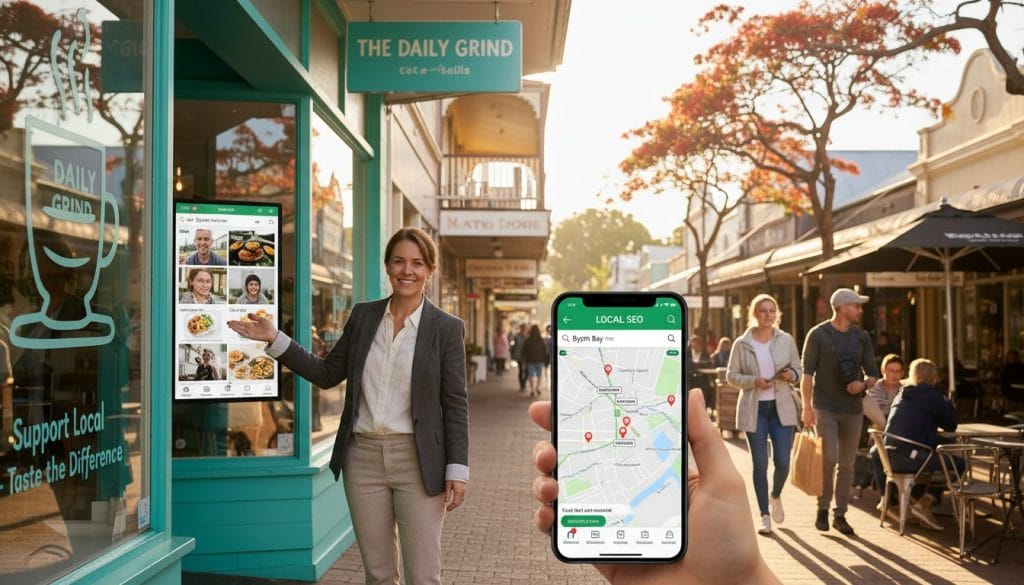
There are two lanes people mix up. One is the map results and the local pack — those three listings with the map pin that grab clicks and calls. The other is the standard blue-link search results on Google.
How Google ranks nearby businesses
- Relevance — match what the customer types; tune your business profile and site copy.
- Distance — being close matters; serve clear suburbs and service areas.
- Prominence — reviews, mentions and steady info build trust and visibility.
What counts as success? More phone calls, more direction requests and more bookings — not a trophy for one keyword. Google says people act fast: about 76% of mobile searches with local intent lead to an in-person visit within a day (Think with Google).
Key Takeaways
- Show up where customers search — Maps and blue links both matter.
- Tune relevance, distance and prominence into actions you can do this week.
- Measure calls, directions and bookings, then improve over 4–6 months.
Key takeaways you can use this week
Pick the easy wins first — the bits you control that turn searches into phone calls.
The three levers you actually control:
Profile, website, reviews
Start with a tidy business profile. It’s the fastest route to calls from Maps and search results.
Next, check your website. Make sure it clearly shows what you do and how to contact you.
Finally, build a steady reviews habit — they persuade people and help your online presence.

Consistency beats hacks
Accurate business information everywhere stops leaks. Same name, address, phone and hours across listings makes Google and customers trust you.
Small tweaks, compounding wins over 4 to 6 months
Don’t expect overnight miracles. Give it 4 to 6 months of steady tweaks and you’ll usually see compounding results, especially in busy suburbs.
- Nail your Google Business Profile basics — fastest path to calls from Maps.
- Keep your website clear — it feeds relevance and trust; people decide to contact or bounce there.
- Create a simple reviews rhythm — ask, remind and respond.
- Lock down consistent business information — boring but critical.
- Run a quick audit first — then fix the easy items and repeat.
If you want a focused checklist for a clinic or practice, see the dedicated guide for SEO for psychologists — it follows the same audit-first approach.
Get your business eligibility and core info sorted first
Sort your core business details first so every change you make actually helps customers find and call you.
First, check whether a Google Business Profile is right for you. To qualify, a business must make in-person contact with customers during its stated hours. If you don’t meet people face-to-face, don’t pin your hopes on a listing you can’t keep.
Eligibility self-check for Aussie businesses
If you visit customers at their place, or run appointments from a staffed office, you qualify. Home-based owners who only take calls but never meet clients should consider alternatives.
Lock in your NAP and hours
Decide one canonical format for your business name, address and phone. Use the same punctuation, suite numbers and opening hours everywhere. Consistent business information stops confusion and lost calls.
Pick the right model and outcomes
Are you brick-and-mortar, service-area or hybrid? Don’t show a home address when you don’t serve walk-ins, and don’t hide an address if customers visit.
- Track what matters: calls, form leads, direction requests, booking clicks and foot traffic.
- Create a one-page business info doc to share with staff and partners — no freelancing your details.
Build a local SEO strategy around real search demand
Spend 15 minutes with Google Autocomplete and a notes app and you’ll have a practical list of service + suburb phrases that point to callers, not browsers.
Find service + suburb keywords with Google Autocomplete
Type patterns like “[service] [suburb]“, “[service] near me” and “[service] in [city]“. Capture the long-tail suggestions — they often reflect actual intent influenced by where you are.
Use competitor gaps to spot untapped opportunities
Quick check: search key phrases and note competitors who rank but don’t list your exact service. Use a simple keyword research tool (eg. Semrush or Keywords Everywhere) to filter volume and difficulty.
Prioritise by intent and feasibility
Pick high-intent terms first — emergency, same-day or quote-related phrases bring calls fastest.
Then ask: can you realistically build a better page than the current top result? If yes, pursue it. If not, shift to an easier, relevant phrase.
- Tools: lightweight keyword tool + rank tracker for monitoring.
- Content plan: main service page for big terms, location pages for suburbs, FAQ snippets for low-effort queries.
- Sanity rule: bin any keyword that attracts the wrong customer, even with decent volume.
Optimise your Google Business Profile to win local pack visibility
A well-kept Google Business Profile can lift visibility on Maps almost overnight. It’s the fastest lever because the profile is literally the object Google shows in the local pack, and that drives calls and direction requests.
Categories, services and attributes that match what customers want
Pick one accurate primary category, then add supporting categories that reflect real services you offer. Don’t guess or overreach — accuracy beats wishful thinking.
Fill services and attributes as a customer would read them: parking, wheelchair access, after‑hours, emergency call‑outs and payment types. These remove friction and increase contact rates.
Photos and videos that build trust fast
Show the exterior so people recognise your place, then team shots, recent work and “what happens next” images that calm nerves.
Keep a simple photo cadence — a few fresh photos each month beats a single dump from 2019.
Posts and Q&A: stay active without living in Google
Post short updates and pre-answer common phone questions in Q&A. Do this once a fortnight and you’ll save time and answer future customers faster.
What to avoid
Don’t stuff keywords into your business name. It looks spammy, can get you penalised and makes a poor first impression — like turning up to a party in a fake moustache.
“Keep it accurate, helpful and human — that’s how you win the local pack and more phone calls.”
Fix and grow citations so Google trusts your business information
A messy set of listings quietly loses you calls; cleaning citations fixes that fast.
What are citations? They’re places your name, address and phone turn up online. Google checks these mentions to verify your details. Consistent citations help your business show up in search and bring real customers through the door.
Structured vs unstructured citations
Structured are directory entries — Yellow Pages, TrueLocal, Bing Places. Unstructured are mentions in news pieces, blog posts or event pages. Both matter: directories give clear signals, while mentions add trust and context.
“SEO consultant Charles Floate recommends getting structured and unstructured citations.”
NAP consistency rules
- Use the exact same business name, punctuation and phone format everywhere.
- Fix old addresses or retired numbers before creating new listings.
- Store one canonical version in a simple spreadsheet and share it with staff.
Where to list in Australia and tidy duplicates
Cover Google Business, Apple Maps, Bing Places, Facebook, Yelp, Yellow Pages and TrueLocal. Add industry directories for tradies, health or hospitality.
Duplicates and outdated listings cause wrong calls and lost customers. Run a quarterly tidy-up and track changes in a spreadsheet so this doesn’t turn into a yearly headache.
| Type | Example | Benefit |
|---|---|---|
| Structured citation | Yellow Pages, TrueLocal, Bing Places | Clear NAP signal, easier to correct |
| Unstructured citation | Local paper article, blog mention | Builds trust and context, helps rankings |
| Directory aggregator | Data aggregators used by multiple platforms | One fix can propagate across many listings |
| Duplicate/outdated | Old branch listing, previous phone number | Causes missed calls and confused customers |
Turn online reviews into a conversion machine (and a ranking signal)
A steady stream of honest reviews drives trust and more phone calls—let’s make that routine.
How to ask for reviews without sounding weird
Keep it simple and only ask if the customer was happy. Short asks work best in person and in messages.
Review management: make it a routine, not a drama
Assign who asks, when and how often. Store your review links in one place so staff don’t wing it.
- Who: front desk or tech completes ask after a positive interaction.
- When: within 24–72 hours while the experience is fresh.
- Where: Google Business Profile plus one other site relevant to your industry.
Response playbook, review velocity and star ratings
Positive: short thanks, call to action if relevant.
Negative: calm, specific, offer next steps and take details offline.
Customers notice star rating and recent reviews first. BrightLocal found 79% of consumers trust online reviews as much as personal recommendations (BrightLocal, 2023). A one‑star shift can change conversions noticeably (Moz/Industry studies).
“Responding shows you value feedback and turns negatives into contact opportunities.”
Example client result: after a review drive and GBP fixes, one clinic saw a 28% lift in incoming calls within eight weeks.
| Channel | Script (copy) | Timing | Purpose |
|---|---|---|---|
| In-person | “If you were happy, could you leave a quick review? It really helps.” | At job completion or checkout | High conversion, personal touch |
| SMS | “Thanks! If we did a good job, would you mind a one-line review? [link]” | 1–2 days after service | Fast, mobile-friendly |
| “Glad we helped — if you’re happy, a quick review here would mean a lot: [link]” | 24–72 hours after service | Good for longer jobs or follow-up |
Compliance: don’t pay for reviews, don’t gatekeep honesty and never argue publicly. Treat reviews like customer care—small, steady attention wins.
Upgrade your website so it supports Maps and organic rankings
Think of the website as the handshake after a search: it backs your Business Profile and converts interest into calls or bookings.
On-page basics: titles, headings, copy and local modifiers
Start with titles and headings that match real services people search for. Use clear keywords and small local modifiers naturally — not stuffing. Your copy must answer four simple questions: can you help me, how much, how fast and where.
Location pages that actually help
Make each suburb page unique. Add service boundaries, travel fees, real photos, FAQs and proof of work. No copy‑paste suburb mad libs — that loses trust and potential customers.
Internal links that guide humans and help Google
Link main service pages to key suburbs, and suburbs back to core pages. Add an obvious mobile path: book → call. Include internal links to useful resources like /seo-audit/ and /local-seo-adelaide/.
Usability: mobile-first, fast and easy to contact
Make pages load fast, add a sticky call button, use click-to-call numbers and simple contact forms. Embed a map where it helps and keep forms short — conversion beats clever forms.
Quick win: run Google Search Console and a basic site audit tool to find pages getting impressions but few clicks. Improve titles and content and watch organic traffic and phone calls rise.
Build local authority with links, partnerships and proof
Authority isn’t mystical — it’s other trusted sites vouching for your business with links and mentions. That kind of endorsement helps your organic and google local visibility, and it’s practical to earn.
Local backlinks that make sense
Think associations, event pages, council and community directories, industry bodies and charity sponsorships. These are real, relevant sites that Australians trust.
Use PR that’s actually newsworthy — a community clean-up or a trade event — and get a link from the organiser or local paper.
Unlinked mentions and broken links
Scan for mentions of your business without links and ask politely for a link. It’s low effort and often works.
Find broken links on partner pages and offer your updated URL as a fix — quick wins that boost trust and search signals.
Quick comparison of focus areas
| Focus | Effort | Speed of impact | Primary outcome |
|---|---|---|---|
| Google Business Profile | Low | Fast | Calls, maps local visibility |
| Citations | Low–Medium | Medium | Consistency, search trust |
| Reviews | Medium | Medium | Conversion, bookings |
| Website | Medium–High | Medium | Organic traffic, pages that convert |
| Links & partnerships | Medium | Slow–Medium | Authority, long-term visibility |
“Backlinks are a strong ranking signal; a Semrush study of 16,000 keywords shows multiple top factors relate to backlinks.”
Practical tip: check competitors for decent links and ask the same sites for inclusion, but put your own spin on the pitch. Small partnerships and proof of work build real results over time.
Conclusion
The aim here is practical: more phone calls and bookings, delivered by steady, sensible work.
Quick checklist you can follow: eligibility and core info, demand research, google business profile, citations, reviews, website, authority and regular tracking habits. Consistency beats hacks; measure calls, directions, booking clicks and form leads so small changes show real results over time.
Next 7 days: confirm NAP, check eligibility, tidy your profile and ask for one recent review. Next 30 days: run a simple audit, fix top citation issues, add a clear call button on your website and build a review routine.
Book a free audit at loudachris.com.au or visit /contact/ and /resources/ for tools and checklists.
FAQs
How long until I see results? Expect steady lifts in 4–6 months for organic wins; GBP and quick fixes can boost calls in weeks.
Do I need a shopfront? No—if you meet customers in person or visit them, you qualify. Hide a home address if you don’t offer walk‑ins.
How many reviews are enough? Aim for a steady stream—recent reviews and responses matter more than a high total overnight.
Competitor stuffing my name? Report spammy business names via the platform, document the issue and focus on honest citations and good reviews to out‑trust them.
FAQ
What exactly is local search and why does it drive phone calls for Australian businesses?
How does Google decide which businesses show in the local pack and on Maps?
What are the most important things to fix first on my Google Business Profile?
How should I choose between a brick‑and‑mortar, service‑area or hybrid profile?
What kinds of keywords should I target to get more calls this month?
How do photos and videos affect my profile’s performance?
What’s the simplest way to get more customer reviews without sounding awkward?
How should I respond to negative reviews so they don’t hurt my chances of getting calls?
Are citations still important, and where should I list my business in Australia?
What should I avoid when optimising my business name and description?
How do I know which suburbs to prioritise for my pages and Maps presence?
What website fixes most directly help Maps visibility and organic rankings?
How do local backlinks and partnerships improve my profile’s performance?
How long before I see results after making these changes?

Chris Lourenco is the director of Loudachris Digital Marketing, an Adelaide-based SEO, Google Ads, and web design agency. Chris excels in crafting bespoke, results-driven strategies that help businesses get more traffic, leads and sales.