
If you’re not on page one, you’re basically invisible — and that hurts enquiries more than a dodgy BAS spreadsheet. This quick guide gives you a simple, practical game plan: seven actions that boost your search presence without turning you into a full-time SEO goblin.
This is for Aussie accountants, bookkeepers and small accounting firms who want real inbound leads, not fluff about “brand awareness vibes”. We’ll cover both local and organic search, and when ads actually pay for themselves.
SEO is earned, not bought. It uses crawlers to index your site and compounds over time, so think long game — you’re building an asset, not chasing a sugar hit.
Chris Lourenco from Loudachris has seen what works in Adelaide and beyond. Consider this the “do this next” version — practical steps you can action this week. I’ll point to a few internal resources later so you’ve got examples and templates to copy.
Key Takeaways
- Being on page one matters — it drives real enquiries.
- Seven practical steps will improve your search presence without complex tech.
- We cover local and organic approaches, plus when ads are useful.
- SEO compounds — expect steady growth, not instant wins.
- Use the guide as a hands-on checklist; Loudachris shows practical examples.
Why “page two” might as well be the Shadow Realm for accountants
Page two is where good leads go to disappear — and that’s bad for business. When people search for help, most stop at the first page. That means fewer eyeballs, fewer calls and fewer quality enquiries heading your way.
Here’s the blunt number: about 95% of searchers never click past page one. Translate that into potential clients and you see why being on page one matters for small firms offering accounting services.
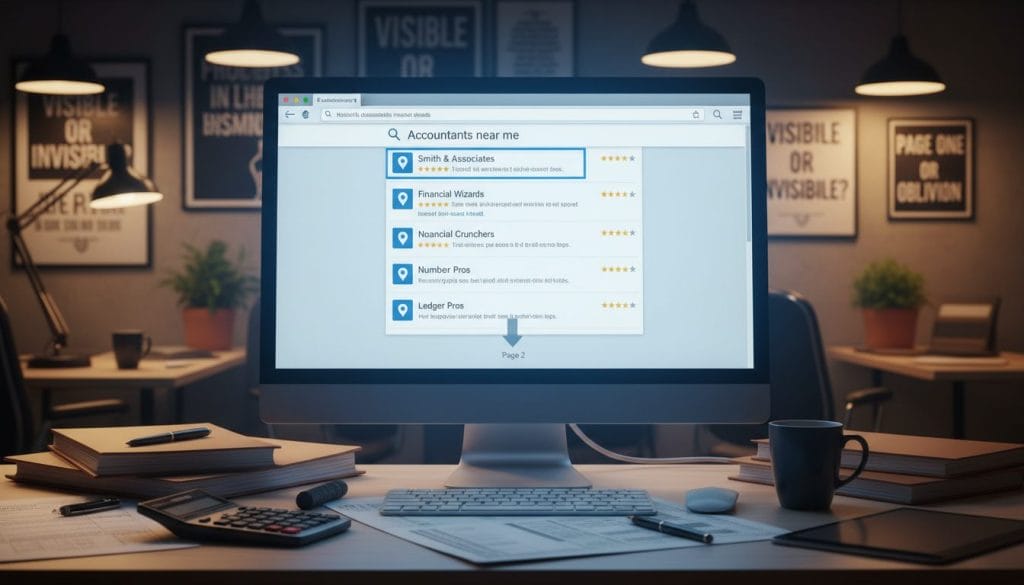
What the page-two drop-off does to enquiries
Less traffic equals fewer form fills and phone leads. Even if your service is perfect, being buried means missed meetings and slower growth. You don’t need fame — just being easy to find when someone is searching saves time and wins clients.
What local intent looks like in Australia
Local searches often include suburb names or phrases like “near me”. Map Pack listings and local search results dominate for location-based queries.
- Map Pack appears first, then organic listings, then the rest fight for scraps.
- Example searches: “tax accountant Adelaide”, “bookkeeper Glenelg”, “BAS agent near me”.
| Metric | Page One | Page Two | Impact on Enquiries |
|---|---|---|---|
| Click-through rate | High (top results ~25-30%) | Very low (<5%) | Big drop in calls and forms |
| Local intent queries | Map Pack + organic | Rarely shown | Local firms miss nearby clients |
| Lead quality | Higher — intent is clear | Lower — casual browsing | Worse conversion rate |
To win, you don’t need to be everywhere — you need to appear where people already search. Next we’ll explain how search engines actually find and rank your firm, so you can flip that first-page switch.
How Google actually finds and ranks your accounting firm online
Understanding how search engines work makes SEO feel less like witchcraft and more like sensible plumbing.

Crawling and indexing in plain English
Think of the search engine’s bots as nosy librarians. They scan pages, follow links and take notes about what each page is about.
Indexing is the library shelf — the engine stores what it finds so it can serve results fast when someone searches.
If a page is blocked, slow or hard to read, the bots skip it. That’s a technical problem you can fix without deep geekery.
Relevance vs authority — the two levers you control
Relevance means your content and keywords match what people type — services, suburbs, and clear answers to common questions.
Authority is earned: links, reviews, local mentions and consistent business info build trust over time.
- Control content — make pages that answer real client queries.
- Build credibility — gather reviews, links and consistent listings.
| Signal | What it shows | How to improve |
|---|---|---|
| Relevance | Match to search queries | Service pages, keywords, clear headings |
| Authority | Trust and reputation | Reviews, links, consistent business details |
| Technical access | Can bots read your site? | Fix indexing, speed, and mobile issues |
Control your content and credibility first. For practical steps, check this guide on SEO for accounting firms.
What showing up in search really means (and what to measure)
Getting found isn’t about fancy keywords — it’s about appearing where people click when they need a service. Think of it as being at the intersection of intent and convenience: the right listing, at the right moment.
Map Pack vs organic: where your next client is clicking
Map Pack (your business profile) acts like a local storefront — phone number, directions and quick info. Organic listings are the website pages that answer questions and convert later.
Both feed enquiries: one grabs urgent local leads, the other builds steady traffic and trust over time.
CTR reality check
The top result gets about 27.6% of clicks. Small moves near the top create outsized gains in traffic and leads, so aim for incremental lifts, not overnight miracles.
Leading indicators to track before rankings move
- Impressions in Search Console — are people seeing your pages?
- Business Profile views and direction requests — local demand signals.
- Calls and clicks from your website — real enquiries you can measure.
- CTR changes — a rising click-through rate often precedes rank gains.
| Placement type | What it looks like | Best for | Key metric | Typical next step |
|---|---|---|---|---|
| Map Pack (profile) | Local listing with map, hours, phone | Immediate local leads | Profile views / direction requests | Optimise categories, photos, reviews |
| Organic results | Website pages and blog posts | Long‑term enquiries and authority | Impressions, CTR, sessions | Create targeted service pages and content |
| Google Ads | Paid listings above results | Immediate traffic and targeted offers | Cost‑per‑conversion | Test keywords and landing pages |
Weekly, watch profile views, calls and CTR. Monthly, check impressions, sessions and conversion trends. Now we know what winning looks like — next up: seven practical steps to get there.
1) Get your Google Business Profile humming for local search results
Make your business profile tidy and truthful so local searchers find your phone number, hours and services in seconds. Optimise your google business profile so Google trusts your location, services and contact details, and nearby clients can call you straight from the Map Pack.
Why this works: local SEO often starts with a clean profile. The listing displays your business name, address and contact information in Search and Maps, so mistakes cost enquiries more than time — they cost clients.
Non‑negotiables: name, categories and services
Use your real business name — no keyword stuffing — pick the best‑fit categories and list the services you actually sell. Clear labels make ranking signals easier to read and improve the chances of relevant results.
NAP basics and useful fields
Format the address consistently, use the correct phone number, add opening hours and link to the exact service page on your site. Clean contact information reduces confusion for potential clients and for search bots.
Photos, updates, FAQs and reviews
Post photos of the office and team, add timely updates (EOFY, tax time) and use FAQs to answer common questions like “Do you take new clients?” or “Do you do Xero?”.
Ask for reviews regularly, respond like a human, and mention outcomes — not client details. For an example checklist, see /local-seo/ or /google-business-profile/ on Loudachris for step‑by‑step help.
2) Clean up citations and NAP so Google trusts your details
Make your business details the same everywhere and stop leaking leads to old listings. Fix your NAP and citations so Google sees one consistent set of business details, which boosts local trust and stops clients calling a dead number or turning up at the wrong office.
In plain language, a citation is any directory entry that repeats your name, address and phone number. These are small signals, but they add up — especially for local search and accounting firms targeting nearby clients.
Where to check first
- Google Business profile (update the profile, once).
- Apple Maps and Bing Places.
- Yellow Pages, TrueLocal and relevant industry associations.
Quick audit and fix process
1) Audit your main listings. 2) Update core platforms first, then secondary directories. 3) Remove duplicates or old entries.
| Step | Why | Field to check |
|---|---|---|
| Audit | Find inconsistencies | Address, phone number, URL |
| Update | Set the single truth | Trading name, ABN name, opening hours |
| Track | Stop regressions | Spreadsheet or citation tool |
Make sure: address punctuation, trading name, ABN name, opening hours and website URL are identical everywhere. Do that and your local SEO strategies and online presence start behaving like a proper receptionist.
3) Build service pages that match real search queries (not your org chart)
Make every service page a direct answer to a common question your potential clients actually ask. Create one clear service page per core offer and write it the way clients search, so people land on the right page — not a vague “Services” dumping ground.
What to include on each page
- Core focus: tax returns, BAS & GST, bookkeeping, advisory, SMSF, payroll, business structuring — only list what you actually offer.
- Local flavour: use natural phrases like “Tax help in Adelaide” and mention suburbs where it reads like a human wrote it.
- Conversion basics: phone, short enquiry form, booking link and a “who it’s for” box (tradies, consultants, small businesses).
- Trust signals: qualifications, memberships and specific outcomes (no client names).
Why one page per service works
Tightly themed pages improve relevance, make internal linking cleaner and lift conversion rates. They help seo and make your website easier to scan for both clients and search engines.
Practical next step: create the page, theme it around the right keywords and link to a resource like /seo-adelaide/ or /seo-for-small-business/ to support the build.
4) Do keyword research like your clients talk (not like accountants write)
Begin by listening to how local businesses describe their problems — that’s where useful keywords start.
Seed your research with the actual services you sell, common problems clients call about and software names like Xero or MYOB. Add suburb names to make phrases local and real.
Expand with the right tools
Use a keyword tool to check monthly volume and difficulty, plus Google autocomplete and Search Console queries to find real search behaviour.
Why long‑tail keywords pay off
- Lower volume but higher intent — people who type long, specific phrases often want to hire.
- Less competition, better conversion odds, cleaner reporting.
- Examples: “BAS agent Glenelg price” vs “what is BAS”.
Map intent and pages
Quick rule: one main keyword per page, then use supporting phrases in headings and FAQs.
- Seed list: services, problems, software, suburbs.
- Expand with a keyword tool and Search Console queries.
- Sort phrases into informational, transactional and navigational buckets.
- Prioritise terms that attract higher‑intent potential clients and lead to better results.
Do this and your content and blog posts will bring fewer tyre‑kickers and more clients who are ready to talk.
5) Publish content that actually ranks (because search engines love words)
Write helpful content that gives quick answers — that’s how you start earning steady enquiries over time.
Publish plain‑English posts that answer real client questions. Without words on the page a search engine can’t rank you, and without clarity people won’t trust you.
“Without content it literally is not possible to rank…”
Evergreen vs seasonal: evergreen guides (how to read financial statements, BAS basics) keep bringing leads long after publishing. Seasonal pieces — tax‑time checklists and compliance updates — need a yearly refresh so facts and links stay correct.
Keep readability high: explain acronyms, show a short example, add checklists and break long ideas into bite‑size paragraphs. Each blog post should link to a relevant service page and invite a soft next step.
Quality rule: make every piece unique, useful and written for Australians. Treat content marketing as a compounding asset — publish, update yearly, and watch it keep bringing in potential clients.
| Type | Purpose | Cadence |
|---|---|---|
| Evergreen guide | Teach core topics, steady traffic | Publish once, review yearly |
| Seasonal update | Tax rules, compliance alerts | Update annually (or on rule changes) |
| How‑to blog post | Answer client questions, convert | Monthly or bi‑monthly |
6) On-page SEO quick wins: titles, headings, URLs, and internal links
Tidy up your on‑page SEO so people and search engines can scan your page fast: clear titles, clean headings, sensible URLs, and internal links that guide users to the next useful step.
Title tags and meta descriptions that earn the click
Keep title tags at ~50–60 characters and include the main keyword. Write meta descriptions that sell the benefit — not a list of services — because a better CTR can lift traffic before rankings move.
Header structure that makes scanning easy
Use one H1, then H2s and H3s for sections and FAQs. Short headings help mobile skimmers and make your content easier to consume.
URLs and internal linking
- Keep URL slugs short, descriptive and readable — no random numbers.
- Link service pages to related blog posts, and blogs back to service pages to share authority across the website.
- Avoid keyword stuffing or robotic suburb spam — write for humans first.
Quick checklist: tidy title, useful meta, one H1, smart internal links. Do this and you’ll often see better CTR and clearer search results for potential clients.
7) Earn quality backlinks without begging strangers on the internet
Build a small number of relevant, high‑trust backlinks by being genuinely useful in your local business community and industry circles. Strong links act like endorsements that lift your authority and help your service pages rank better in search.
Why one strong backlink can beat a hundred weak ones
Link quality matters: relevance, trust and context beat sheer volume. A reputable site linking to your useful guide sends a clearer signal to the search engine than dozens of low‑quality directories.
Local partnerships and relevant publications for accounting firms
- Join your local chamber or industry association and offer a short guide or guest insight.
- Sponsor a community event and ask for a link from the organiser’s site.
- Provide comment or analysis to local news or business publications — they love plain information.
- Get listed on software partner directories (Xero, MYOB) and relevant industry resource pages.
Publish a practical checklist or local tax guide and share it with partners — content like that attracts natural links. Avoid paid link schemes, random directories and anything that looks spammy.
Do this and the boost in authority will help your service pages, not just your blog posts, reach more potential clients.
Technical SEO that stops Google and users from rage-quitting
Technical issues cost real enquiries. Visitors punish slow pages and cluttered mobile sites by leaving, and search engines are less keen to send traffic to a slog.
Page speed targets are simple: aim for 0–2 seconds load time. Most users won’t wait more than about six seconds, so shaving a few seconds makes a big difference.
Page speed targets and what usually slows sites down
Huge hero images, bulky themes, too many plugins, cheap hosting and uncompressed PDFs are common culprits. Fix the biggest offender first — often it’s that oversized image on the homepage.
Mobile-first indexing: what search engines are moving towards
About 60% of global traffic is from mobile devices. If your mobile site is a mess, rankings suffer because the crawler uses the mobile version to judge pages.
Image optimisation basics (file size, filenames, alt text)
Compress images, use descriptive filenames, and write clear alt text for accessibility and better indexing. Small files speed pages and help users on slow connections.
Make sure: run PageSpeed Insights, load the site on a phone, then fix the main bottleneck first. These technical fixes amplify the other tactics — they don’t replace them.
Use schema markup to win richer search results real estate
Schema markup is a small technical change that helps search tools understand your pages and show richer search results. It translates your page content into clear signals about your business, services and contact information so the right people see the right info fast.
LocalBusiness and ProfessionalService for accounting firms
For local accounting sites, the two helpful types are LocalBusiness and ProfessionalService. They flag your trading name, address, opening hours and service types. Keep these details identical to your business profile and NAP on the website.
Review snippets and richer listings (where eligible)
Rich snippets — star ratings, price ranges or FAQs — can lift CTR without changing rankings. Eligibility varies, so don’t fake reviews and follow the guidelines. Honest review data can earn you more clicks and trust.
- Think of schema as a translator for search tools.
- Use LocalBusiness or ProfessionalService schema for accounting pages.
- Match schema to your business profile and NAP exactly.
- Implement via a plugin, developer, or an SEO tool and test with rich results testing tools.
Practical next step: add basic schema to a service page, test it, then expand across the site. Small wins here often pay off with better search results and more qualified visits.
Turn trust into clicks: reviews, testimonials, and proof on your website
Proof on your site works like a trusted referral — but faster and always on. When potential clients see real outcomes, hesitation drops and conversions rise, even if traffic stays the same.
Where to place social proof on service pages for maximum impact
Place short testimonials near the top of a service page so new visitors see reassurance immediately.
Also add proof beside pricing cues, next to the contact form, and in FAQs where people look for extra information.
Testimonial and review best practice
- Format: outcome, timeframe, problem solved — keep it specific but not private.
- Permission: always get sign‑off and use first name plus suburb for authenticity.
- Embed reviews: show recent reviews on your profile and select a few on the website to stay current.
- Compliance: never share sensitive financial details; describe benefits and results at a high level.
Your future client wants reassurance they’re choosing a safe pair of hands. Make proof human, relevant to the services you offer, and easy to scan — and you’ll turn cautious browsers into real enquiries.
Social media and video: visibility boosters that support SEO (not replace it)
Social channels and short video are great at amplifying your work — but they don’t replace a tidy website or steady seo.
Use social media as the megaphone and your website as the home base. Social brings attention; the website converts that attention into enquiries.
Video benefits: dwell time, rich media signals, CTR uplift
Videos keep people on a page longer. That longer session time can help search engines see your content as useful.
Thumbnails also boost click-through rates in search results and social feeds. Rich media can surface in both video search and standard results.
Webinars, explainers and podcasts that match client questions
Turn common queries into short explainers: tax-time checklists, BAS deadlines, “what to bring” guides, and cashflow basics for small businesses.
Run one webinar, then edit it into several short social posts and a full video you embed on a relevant service page or blog post. This extends reach and keeps content working for longer.
| Asset | Use | Where to host |
|---|---|---|
| Short clip | Social sharing, reels | Platform + embed on website |
| Full webinar | Lead magnet | Website landing page |
| Podcast | Long-form answers | Podcast host + show notes on blog |
Keep it simple: good audio, clear answers and a call to action. You don’t need Hollywood gear — just helpful content that points people back to your website and services.
Track what’s working with conversion tracking and analytics
Tracking conversions turns guesswork into a simple scoreboard you can actually trust. Rankings are vibes; conversions are the reality that pays the bills. Use a basic analytics tool and a tracking plan to see which pages, keywords and content actually drive enquiries.
What to track: calls, forms, downloads, and booked consults
- Phone calls — click‑to‑call events from mobiles.
- Form submissions — enquiry or quote forms that capture leads.
- Bookings — confirmed consults or calendar events.
- PDF downloads — guides that qualify interest.
- Direction requests — GBP map actions that show local intent.
Use analytics to refine keywords, content, and landing pages
Look for pages with decent traffic but low conversions. Tighten copy, add proof, and sharpen CTAs. Use search queries from your analytics to prioritise keyword opportunities and improve on‑page content.
One Adelaide accounting firm we worked with at Loudachris cleaned up tracking and service‑page messaging, and saw a 38% lift in qualified enquiry forms over 8 weeks. Chris Lourenco helps set up clean tracking so you can see what’s actually making the phone ring.
Quick motivation: organic search is still the best ROI for almost half of marketers — 49% say it delivers top returns — so track it properly. For help, see /seo/analytics and Book a free audit at loudachris.com.au or visit /free-audit/ for an example plan.
When to layer in Google Ads for extra visibility (without living on a budget drip)
Ads let you appear for high‑intent searches immediately — without waiting months. Use them when you need leads now, or when peak season means every search could be a paying client.
Keyword targeting and ad copy that matches intent
Pick keywords that signal buying intent. Avoid broad curiosity terms that waste budget.
Match ad copy to intent: speak to the problem, promise a clear next step, and send clicks to a relevant landing page on your website.
Geo-targeting for local clients (radius and suburb targeting)
Limit bids to the suburbs and radius you actually serve. If you only take clients within 20km, don’t pay to show outside that area.
Use suburb-level targeting to prioritise high‑value neighbourhoods and protect your cost‑per‑conversion.
A/B testing and bid strategies to protect cost‑per‑conversion
Run simple A/B tests on headlines and landing pages before lifting bids. Test one element at a time.
Use automated smart bidding only after you have consistent conversion data — otherwise manual control keeps costs predictable.
Remember: paid ads support SEO and marketing strategies — they don’t replace the long‑term value of your website content. Treat PPC as a temporary amplifier while your organic results build.
| When to use ads | What to target | Primary goal |
|---|---|---|
| Need leads fast | High‑intent keywords | Immediate enquiries / calls |
| Peak season push | Service + suburb combos | Dominate local search results |
| Test offers | Different headlines & CTAs | Find best converting message |
Conclusion
You’ve got seven practical ways to lift your search presence — now make a start.
Quick recap: polish your google business profile, fix citations, build clear service pages, do client‑speak keyword research, publish useful content and a blog, tidy on‑page SEO, and earn quality backlinks. These seven moves compound over time — seo rewards steady effort, not panic edits.
Two‑week game plan: day 1–3 fix your profile and NAP, day 4–7 publish/update a service page, day 8–11 run keyword checks and tweak titles, day 12–14 ask for reviews and share a short guide.
If you want a second set of eyes, Loudachris can point to the biggest wins. Read /local-seo/ or Book a free audit at /free-audit/. The article finishes with an FAQ covering timelines, Map Pack vs organic, blogs and review counts.
FAQ
What does “page two is the Shadow Realm” mean for my accounting firm?
How does local intent show up in Australian search results?
How does Google find and index my firm’s website?
What’s more important—relevance or authority?
Should I worry about Map Pack vs organic listings?
Is the top organic result really worth chasing?
What early metrics should I track before rankings move?
How do I optimise my Google Business Profile for local search?
Where should I list my firm to clean up citations?
How do inconsistent listings harm local SEO?
How many service pages should my site have?
How do I add location info without sounding robotic?
How do I do keyword research like clients talk?
Which long-tail keywords should I target?
What content actually ranks for accounting firms?
How often should I update tax and compliance content?
What are simple on-page SEO wins I can do today?
How do I earn quality backlinks without cold-emailing strangers?
What technical issues commonly slow accounting sites?
Why is mobile-first indexing important?
Should I use schema markup for my firm?
How do reviews and testimonials turn into clicks?
Can social media and video help SEO?
What conversion actions should I track?
When should I add paid search to my strategy?
How can A/B testing improve my ads and landing pages?

Chris Lourenco is the director of Loudachris Digital Marketing, an Adelaide-based SEO, Google Ads, and web design agency. Chris excels in crafting bespoke, results-driven strategies that help businesses get more traffic, leads and sales.