
2026 isn’t about doing more stuff; it’s about doing the right bits faster. If you run a small or growing business, this guide is your quick, no-nonsense playbook. Think less guesswork, more trust — and moves that actually lift sales and growth.
Journeys are messy now — audiences bounce from AI chats to video to your site. Funnels are pretty much cooked, so we focus on visibility, trust and conversion over vanity metrics.
Here’s what you’ll get: six clear trends, a direct answer up front for each, and practical next steps you can try this year. I’ll point to deeper guides at Loudachris Digital Marketing and sketch internal link plans for loudachris.com.au/blog and later to /services/seo, /services/google-ads and /services/cro.
Key Takeaways
- AI agents change how audiences find answers — plan for agents, not just clicks.
- Answer-first search (AEO, voice, visual) demands concise, helpful content.
- Build first-party data with consent to power personalisation and trust.
- Shoppable short video lifts conversion where attention is shortest.
- Authentic creator content and UGC beat polished ads for real connection.
AI-native marketing gets real: from tools to autonomous agents
Direct answer: AI-native means tools become teammates — autonomous agents that plan, test and reallocate budgets so campaigns run faster and learn quicker, while you keep the brand direction and final say.
Autonomous agents now do real campaign work: they draft creative variants, launch A/B testing, pause poor performers and double down on winners. That shift turns manual chores into continuous optimisation cycles.

Autonomous agents that plan, test and optimise
Practical example — an agent builds 10 variants, runs testing for a week, then shifts spend away from low performers. Marketers set guardrails; agents handle the grunt work.
Creative cycles shrink fast, but human judgement matters more
Yoghurt Digital notes creative cycles can compress by up to 70%. That means faster shipping and faster learning, but humans still pick voice, offers and ethical boundaries.
Agent-to-agent interactions: when bots shop and compare for people
Expect agent-to-agent shopping: product feeds talk to personal assistants, comparing price, stock and reviews so customers see results without opening ten tabs.
Where AI helps most
- Segmentation and predictive insights
- Ad creative testing and always-on optimisation
- Budget shifts and performance-driven spend
One Adelaide service business we worked with cut wasted ad spend and lifted qualified leads after tightening targeting and letting smarter testing run weekly.
Want help setting up smarter testing and budget rules? See loudachris.com.au/services/google-ads
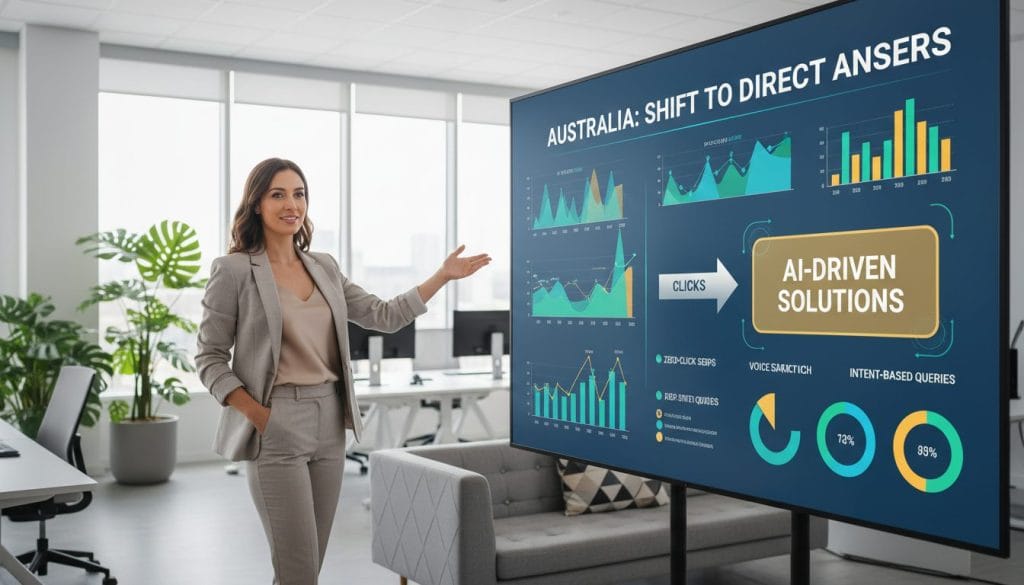
digital marketing trends Australia 2026: search shifts to answers, not clicks
The win now is being the chosen answer — even if clicks fall. If an LLM, AI overview or app cites your content, you earn trust, assisted conversions and brand recall. That matters more than raw sessions; plan to be the quoted source across platforms, not just page one.
AI-first browsing and zero-click discovery
Zero-click and AI-first browsing mean KPIs must broaden. Track share of voice, branded search lift and assisted conversions rather than only sessions.
| Old-school SEO goal | 2026 answer-first goal | What to do |
|---|---|---|
| Rankings for keywords | Citations and concise answers | Write clear definitions, short excerpts and schema |
| Single keyword pages | Entities and topic hubs | Build structured hubs linking FAQs and deep pages |
| Long blog posts | Sectioned content for quick extraction | Use headers, lists, and FAQ blocks |
| Last-click attribution | Blended measurement | Combine Search Console, CRM notes and CRO metrics |
| Google-only visibility | Multi-platform presence | Create LLM-friendly Q&A, short videos and transcripts |
Answer Engine Optimisation and structure
Use clear headings that answer questions, schema markup and short how-to steps. FAQs and crisp definitions make content easy for LLMs to cite.
Voice, visual search and platforms
Write like people speak, add descriptive alt text for product images, and produce short explainer videos that match YouTube and chat-first discovery. Expect users to pinball across apps — measure influence accordingly.
Practical step: start a structured hub and add schema; see loudachris.com.au/services/seo for foundations.
Privacy-first marketing and first-party data become the main event
Direct answer: Privacy-first isn’t a legal tick-box — it’s a commercial advantage if you earn permission, use clear messaging and treat people respectfully. Build first-party signals with simple value exchanges and you’ll get higher-quality data, better conversions and more resilient customer relationships.
Third-party cookies are effectively gone, so businesses must rely on first-party signals, cleaner tagging and an owned-audience plan. That means asking customers for permission and giving something genuinely useful in return.
Why cookie changes matter in practice
Less third-party tracking means more focus on site events, CRM links and consent records. Clean tagging and clear consent logs save time when platforms change rules again.
Value exchanges that actually earn opt-ins
- Gated tools and calculators that solve a real problem
- Email sequences with useful tips, SMS for urgent stock or quote reminders
- Loyalty perks, waitlists and maintenance schedules for tradies and local services
Trust as a growth lever
Use short privacy copy, a preference centre and easy unsubscribes. Say what data you collect and why — that simple honesty builds trust and lifts list quality.
Practical step: start small — add a clear opt-in on forms and test an email welcome series. For guides on first-party tracking and flows, see loudachris.com.au/blog.
Short-form, shoppable video turns attention into action
Direct answer: Short-form video is the fastest route from “who are you?” to “take my money” — but only if clips solve a small problem, show the product clearly and remove checkout friction. Make it useful, not shouty, and let the commerce layer do the hard work.
Short clips grab attention because people scroll for snacks, not long reads. Platforms reward high retention, so useful content gets more reach and more chances to convert.
Why Reels, Shorts and TikTok keep winning
They match real behaviour: scroll, snack, save and share. Algorithms boost videos that hold attention, so one well-structured clip can earn big organic reach.
Shoppable formats that close the gap
Use product tags, in-video shopping and catalogue feeds so people can buy without leaving the app. Still keep landing pages fast for those who click out — speed kills drop-off.
Make it useful: micro-content buckets and filming rhythm
Focus on 3–5 buckets: quick demos, before/after, pricing explained, myth-busting and customer POVs. Film with this rhythm:
- Hook in 1–2 seconds.
- One clear point per clip.
- Captions on, show the product, then a natural call to action.
Measure view-throughs to site visits, add-to-cart and assisted conversions — don’t expect every clip to close the purchase. For turning attention into checkout frictionlessly, see loudachris.com.au/services/cro.
Authenticity wins: micro-influencers, UGC, and unmistakably human brands
Direct answer: When content all blurs into the same beige voice, people stop caring and move on — so lean into real scars, real customers and a clear point of view. The algorithm can copy your format, but it can’t copy your lived experience, so make people the centre of your brand.
Evidence: Yoghurt Digital found that audiences now spot generic AI copy quickly. Kantar shows 36% of people will splurge on small joys — that’s your window to sell honestly without sounding pushy.
Why “same-same” content bounces
Same-same AI content feels safe and forgettable. Think generic tips, bland tone and no clear opinion. People skip it because it has no personality and offers no trust signal.
Micro and nano creators beat reach for trust
Small creators bring niche audiences and stronger engagement. They trade reach for real connection — ideal for brands wanting loyal customers. Brief them clearly: outcomes, tone, and one must-have line, then let them be themselves.
UGC systems that actually work
Ask for reviews at the right time, prompt video testimonials post-purchase, and offer small non-monetary incentives that keep credibility intact.
Repurpose clips across product pages, ads and social posts to build proof at scale. We’ve seen the human stuff outperform polished ads when it’s consistent.
Treatonomics: sell small joys without the guilt trip
Use bundles, limited drops and little add-ons that feel like harmless wins. As Bia Bezamat says:
“CMOs need to ask if their brands are meeting consumers where they are, by creating joy in the everyday.”
In practice, make the “treat” feel like a clear win — simple benefits, fast delivery, no shame.
| Goal | Action | Quick win |
|---|---|---|
| Show real proof | Collect short customer videos | Feature one per product page |
| Build niche trust | Partner with micro creators | Run a 4-week test with 5 creators |
| Sell small joys | Launch limited add-on bundles | Track uplift in AOV and repeat purchase |
Want a quick playbook for creator briefs and UGC flows? Check this practical guide for small food services: meal prep creator playbook.
Conclusion
Growth now comes from small, steady moves that stack into real results. Quick recap: what to start doing — build answer-first pages, short shoppable clips, and consented first-party lists. What to stop obsessing over — raw sessions and vanity metrics. What to measure instead — citations, assisted conversions and conversion rate optimisation.
Next 30 days: audit tracking and consent, refresh top pages for AEO and structure, make 10 FAQ videos, set a UGC capture loop, test one AI-assisted workflow and prioritise CRO fixes. See practical guides at loudachris.com.au/services/cro and loudachris.com.au/blog.
FAQ
What’s the biggest change in SEO for 2026 in Australia? Structured, short answers win. Write clear definitions, use schema and make pages easy for LLMs and voice assistants to cite.
How do I measure marketing if zero-click search grows? Blend Search Console, CRM and CRO metrics. Track assisted conversions, brand lift and citation share rather than only last-click sessions.
What first-party data should a small business collect? Collect consented email, purchase intent, site events and simple preferences. Offer clear value in return and keep records tidy for better optimisation.
Optimise for answers, trust and conversion — not just clicks and impressions. Book a free audit at loudachris.com.au
FAQ
What does “AI-native marketing” mean for my business?
Will autonomous agents replace my marketing team?
How does “search shifting to answers” change SEO work?
What is Answer Engine Optimisation (AEO) and why should I care?
How should I prepare for voice and visual search?
With cookies gone, how do I keep data flowing?
What counts as a fair value exchange to earn consent?
How can short-form shoppable video increase purchases?
Are micro-influencers still worth the investment?
How do I prevent my content from feeling like “same-same AI output”?
What metrics should I focus on in this changing landscape?
How do I test new platforms and formats without wasting budget?
What’s the quickest way to build trust online today?
Should I invest more in paid ads or creator partnerships?

Chris Lourenco is the director of Loudachris Digital Marketing, an Adelaide-based SEO, Google Ads, and web design agency. Chris excels in crafting bespoke, results-driven strategies that help businesses get more traffic, leads and sales.